3150


Natural eutrophic lakes with Magnopotamion or Hydrocharition - type vegetation
Syntaxonomy. Lemnion minoris Tuxen 1955: Lemnetum trisulcae Knapp et Stoffers 1962, Riccietum fluitantis Slavnic 1956, Wolffietum arrhizae Miyawaki et J. Tuxen 1960, Lemnetum minoris Muller et Gors 1960, Ricciocarpetum natantis Segal 1963, Lemno-Spirodeletum Slavnic 1956, Lemnetum gibbae Miyawaki et J. Tuxen 1960; Utricularion vulgaris Passarge 1964: Lemno-Utricularietum vulgaris Soó 1928, Hydrocharition Rubel 1933: Hydrocharitetum morsus-ranae van Langendonck 1935, Stratiotetum aloidis (Nowiƒski 1930) Miljan 1933, Ceratophylletum demersi Hild 1956; Nymphaeion albae Oberdorfer 1957: Myriophyllo-Nupharetum Koch 1926, Nupharo lutei-Nymphaeetum albae Nowitski 1930, Potamo natantis-Nyphaeetum candidae Hejný ex Hejný et Husak 1978, Polygonetum amphibii (natantis) Soó 1927; Magnopotamion (Vollmar 1947) Den Hartog et Segal 1964: Potametum panormitano-graminei Koch 1926, Potametum lucentis Hueck 1931, Potametum perfoliati (Koch 1926) Passarge 1964, Elodeetum canadensis Eggler1933, Myriophylletum spicati Soó 1927, Myriophylletum verticillati Soó 1927, Potametum nodosi (Soó 1960) Segal 1964; Parvopotamion (Vollmar 1947) Den Hartog et Segal 1964: Parvopotamo-Zannichellietum palustris Koch 1926, Potametum trichoidis Freitag et al. 1956, Najadetum marinae (Oberdorfer 1957) Fukarek 1961, Potametum crispi Soó 1927.
Species:
Batrachium circinatum ,
Ceratophyllum demersum ,
Ceratophyllum submersum *,
Elodea canadensis ,
Hydrocharis morsus-ranae ,
Lemna gibba *,
L. minor ,
L. trisulca Photo: С. Майоров.
Myriophyllum spicatum ,
M. verticillatum ,
Najas major ,
Nuphar lutea ,
Nymphaea candida *,
Nymphaea alba *,
Polygonum amphibium ,
Potamogeton crispus ,
P. lucens ,
P. natans ,
P. pectinatus ,
P. perfoliatus ,
P. pusillus *,
P. trichoides Photo: В. Папченков,
Spirodella polyrhiza ,
Stratiotes aloides *,
Utricularia vulgaris ,
Wolffia arrhiza ,
Zannichellia palustris *;
mosses:
Riccia fluitans ,
Ricciocarpus natans .


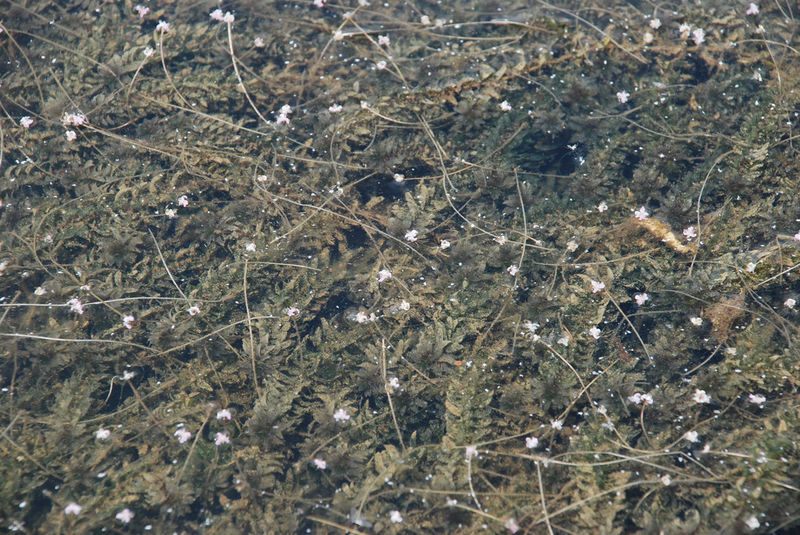


Structure. Habitat includes communities of rooted and freely floating plants with vegetative and generative organs, immersed in the water depth or floating on its surface. Usually, communities are represented by three layers, of which submerged and above-water ones are the most developed. Communities of the class are mainly monodominant but highly mosaic and mobile depending on the water level and season. In the shore shallow areas their specific composition is enriched by the rooted hydrophyte plants (
Sagittaria sagittifolia ,
Butomus umbellatus ), which are only partially submerged in the water. However, most of species which are typical for this type of communities cannot stand substrate drying up. This habitat is considered as the largest as to its size and one of the most widespread on the investigated territory among freshwater habitat types.

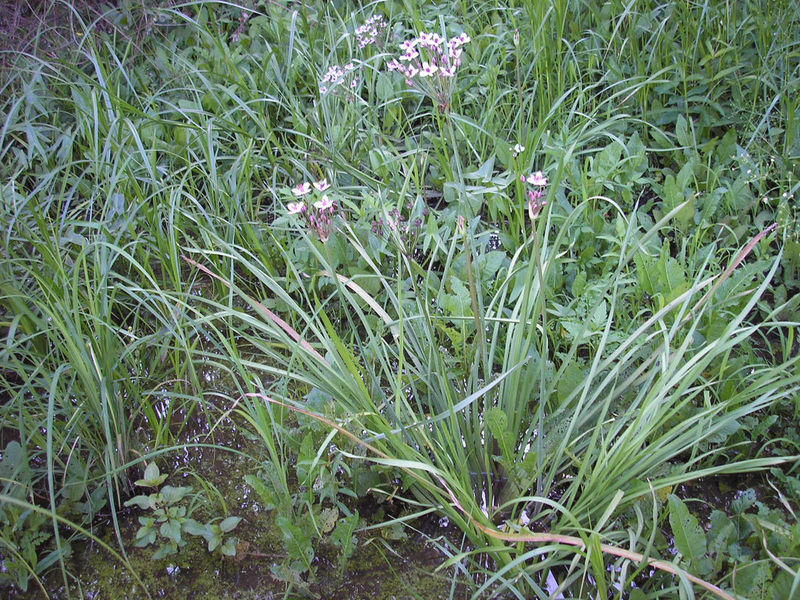
Ecological characteristic. Communities are widespread in mesotrophic and mesoeutrophic permanent basins with slow or absent flow such as lakes, meander lakes, as well as channels, ponds, former quarries. They mainly occur on silty, rarely sandy or peaty sediments which are rich in nutrients, with a thick sapropel layer. An acological optimum of the communities include shallow eutrophic basins with slowly flowing or standing water (especially meander lakes) and a high content of organic substances. Water depth is slight – 50-100 cm (rarely to 250 cm), рНн2о is 5-8,5.
Threats. Changes of hydrological regime (overgrowing of meander lakes and river creeks, adjustment of floodplains), change of the traditional methods of fishery (breeding of the herbivorous fish), the annual ponds cleaning, application the herbicides, excessive recreation, pollution and eutrophication.
Management. Maintenance of the traditional management methods in fish ponds and the natural flow of the rivers with the formation of meanders, meander lakes and blind river arms.
References. Борсукевич, 2010; Дубина, 2006; Дубына, Гейны, Гроудова и др., 1993; Дідух, Фіцайло, Коротченко та ін., 2011; Кіш, Андрик, Мірутенко, 2006; Chytrý, 2011; Chytrý, Kučera, Koči (eds.), 2001; Špániková, 1985; Stanova, Valachovič (eds.), 2002; Valachovič et al., 1995; Viceníková, Polák, 2003.
Author: L. Borsukevych.